
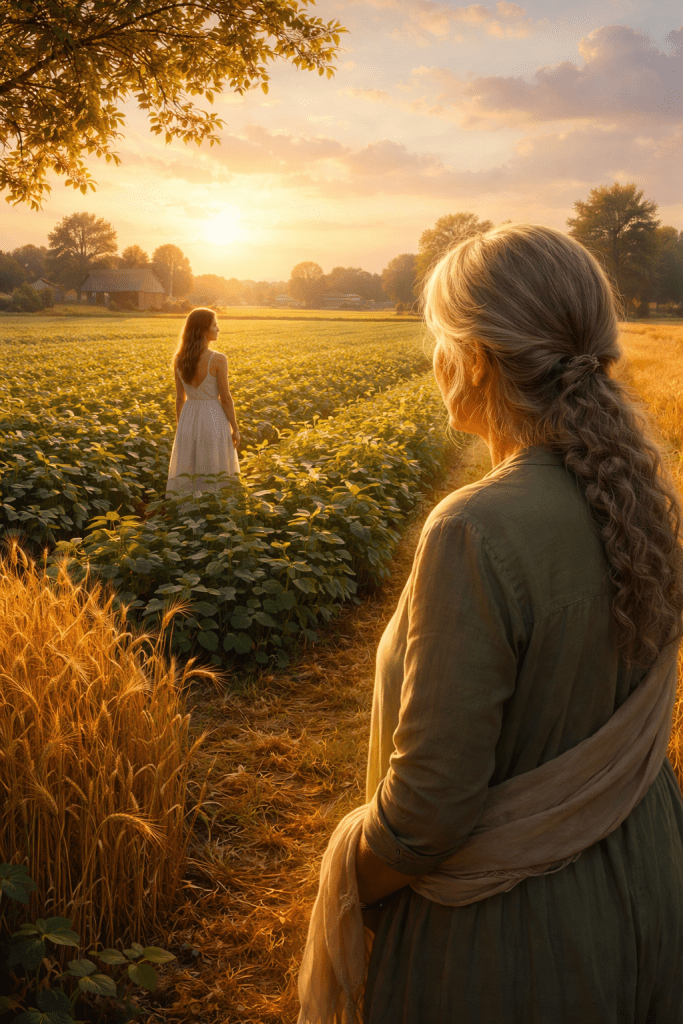
Reflections of youth in golden fields of changing times and choices.
Growing up in a small rural farming town in Indiana in the middle of the last century gave me a close view of how beliefs take root and how they shape what we see. I hope that today those growing up will have a more expanded understanding of the world, yet so often our perspectives are shaped by parents, grandparents, and community, passed quietly from one generation to the next.
My parents were more open than many around them. My father had served in the military and was a Master Mason, and both of my parents had traveled and studied beyond our little town. Still, they worked hard—my father on his small twenty-acre farm, in a factory as a foreman, and even attending college classes at night. My mother tended a large garden, canned food, cared for the home, worked full-time at the factory, and also went to college. They lived in constant motion, yet every Sunday they made time to rest by the lake. In our community, this dedication to work and family was the norm.
The people of that place were good-hearted—connected to the land, the seasons, and one another. But as technology advanced, manure gave way to fertilizer, and pesticides replaced the natural methods once used to balance life. The world was moving toward what was called progress. Nearby Amish communities held to the old ways, quietly enduring the teasing of younger generations who did not yet understand their peace.
Diversity was rare. Few families of color lived in our area, and those who came often found it difficult to be accepted. Indiana, after all, had been home to strong undercurrents of the Ku Klux Klan in earlier generations. My parents, however, never taught or practiced prejudice. They judged people only by their actions, never their appearance. They taught Sunday school, took us to church, and lived their faith through kindness.
If prejudice existed around us, it was often religious rather than racial—disagreements about belief more than hostility toward people. Most followed the political or religious path of their parents, rarely questioning it. Change of belief was considered rebellion. That pattern still echoes through the generations.
My parents allowed me to explore my own understanding of the Divine, though they made sure I attended church on Sunday. When I was a teenager, a confrontation with our minister over his judgmental attitude toward my friends and me led me to walk away from that church—and, years later, my father did the same after his own disillusioning experience. It was a lesson in finding truth for oneself rather than conforming out of fear.
During those years I also saw the struggle of migrant families whose children drifted in and out of school, following the crops. We had no language classes then, and their efforts to learn and belong moved me deeply. By high school, some Hispanic families had settled, and one of my closest friends was Hispanic. Her family welcomed me as one of their own. I also remember the single Black family who came to town; the daughter faced such resistance that they left within a year. The sorrow of that memory still lingers.
In the larger cities nearby, civil rights protests were taking place, and though outward change was beginning, inward change came much more slowly. Even in the 1970s, when I lived in Fort Wayne, there were still invisible lines dividing neighborhoods by color. It became clear that transformation of society begins within hearts, not by laws alone.
When we step beyond our comfort zones—the familiar land of our upbringing—we encounter new people and ideas. We may retreat in fear or open to the deeper work of seeing beyond appearances, politics, or belief systems to perceive the soul within each being. Every one of us carries filters shaped by our experiences, and these filters color our perceptions until we consciously lift them away.
True evolution of perception happens by choice, not by force. Change that is imposed through fear or control only deepens resistance; change that arises from awareness brings expansion. Each soul must find its own timing to release limitation and move into a greater understanding. It is not easy—especially in small communities where change comes slowly—but the call of the heart will always guide us toward truth.
The task is to speak and live our truth without judgment, without the push of a warrior’s sword, but through presence, compassion, and care. This is how we heal perception and remember our shared humanity.
May we each find the courage to see beyond the filters of habit and fear
and to recognize the light of the soul in every being we meet.
🌹 The Emerald Rose of Understanding — may its petals open in all hearts.
I Am Sha’Na’El’-Ka’Zira
I wanted to add a message to this blog that this is in no way an intent to disparage the rural farmers or small HEARTLAND communities. I love the Heartland and the people who are strong, hard working and caring people. Farmers are connected to the land and Lady Gaia in ways that people in urban settings don’t understand. They don’t ask for help unless they are desperate for that is not how they are taught. You work hard and the harvest is your reward. I simply wanted to share that we can stay in our comfort zone all of our life that is our choice. However, if it isn’t working for you and your want something different then let go and step out and trust your inner guidance, not the past beliefs that might be limiting you.

 Oracle of Divine Grace