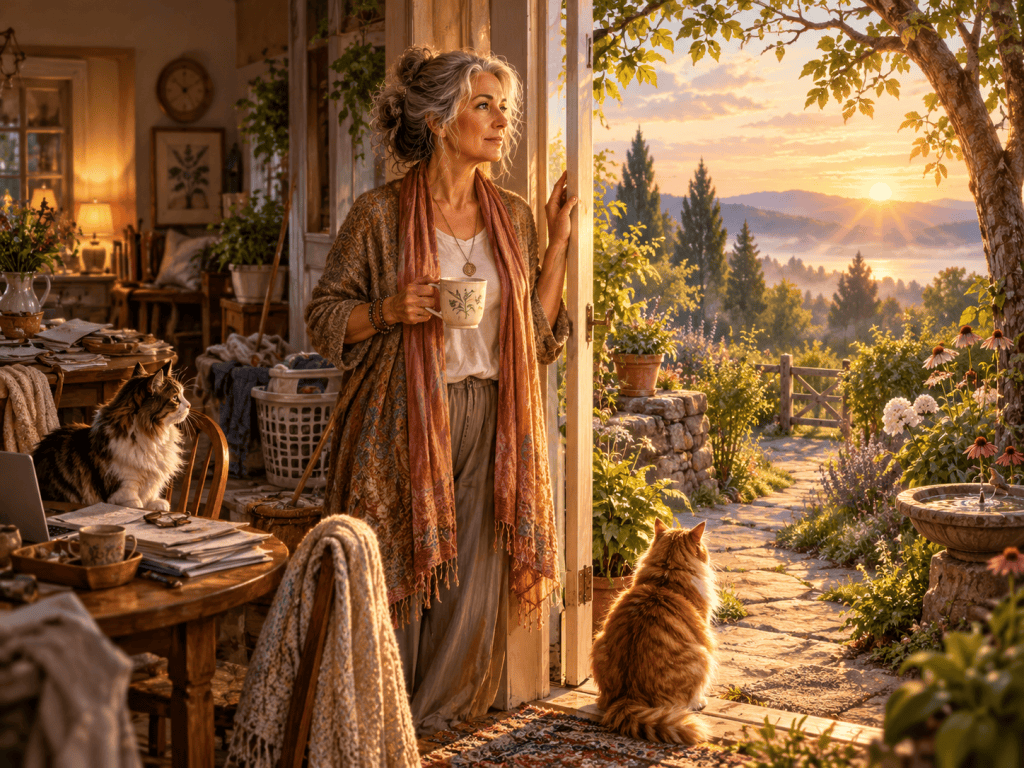
I must admit that last night I slipped into a bit of a depression. Earlier in the week, I had taken a tumble while carrying a tray of food to feed the kitties. I slipped on a rug in the doorway—a rug I have crossed for eighteen years without incident. It was rather embarrassing, and I have been dealing with some physical discomfort and pain ever since.
I am also trying to encourage the eight raccoons who have come to regard this as their feeding station to move on, now that the youngsters are old enough to forage for themselves. I do not want them to starve, but I know they are wild animals. My neighbors are not fond of having them around, nor are my cats, and the raccoons leave quite a mess. More importantly, there may come a day when I can no longer care for all these animals. I want the raccoons to be able to fend for themselves rather than risk being harmed by people who do not welcome them.
On top of that, I am tired of bookkeeping, ready for the season of outdoor chores to end, and trying to summon the desire to finish decluttering my home.
I have also been feeling that I have not made the progress I had hoped for in my spiritual journey and service work. Perhaps I need to step away for a moment and discern what truly needs to be done. I have felt a bit overwhelmed.
I share all this because sometimes it is not one great challenge that brings us to a standstill, but many smaller things layered upon one another. We keep moving forward until something tips the scales, and suddenly we no longer have the energy or desire to push ahead.
As an empath, I believe that unless we are fortified and clear, we can absorb the energy of mass consciousness along with what we are already working to clear within ourselves. And heaven knows there is plenty of that energy in the world right now. When we grow tired, our shields can weaken, and we may feel out of alignment with the flow.
Spiritually, I also recognize that a physical fall, an “accident,” or even an illness can invite us to pay attention and slow down. Sometimes I see such experiences as a nudge from the Higher Self to notice something that needs our care.
So I went to bed early. When I awoke, I found a notification for a video from a reader I enjoy watching. She was speaking about what we might each examine during the final months of the year. Her message had been inspired during a meditation class, when Spirit invited her to reconsider those moments when we think we cannot do something or do not know how we will get through it.
STOP. Then ask yourself: HOW CAN I?
Part of what she shared echoed messages I have been receiving and writing about, including yesterday’s reflection. Yet she offered a wonderfully practical way to approach them. Since I love synchronicity, I wanted to share these insights with you.
She began by speaking of the astrological influences of this period, particularly concerning finances, values, and relationships. The message she received was that, through the end of the year, we would benefit from taking stock of why we do what we do—and why we sometimes believe we can no longer do it. Perhaps we have allowed too much outside input, including news and social media, to fill our minds and hearts.
We were encouraged to examine temptations, habits, and compulsive behaviors that may be holding us back. She shared how, when overwhelmed or bored, she sometimes found herself shopping online and buying things she did not really need. Now she steps away before pressing the purchase button. More often than not, she decides not to buy the item. I have found that this same practice works for me.
We were also reminded to raise our vibration, shake out the cobwebs, and spend time grounding in nature. This can help restore clarity and peace of mind as we ask how to move forward—and which direction to take first.
Another suggestion was to speak our prayers and needs aloud rather than holding them only in our thoughts. In this spiritual understanding, the spoken word helps give expression to intention and manifestation.
Meditation is an important means of alignment and receiving direction, but meditation does not have to mean sitting silently in one place. Some of us find contemplation while walking in nature. Others connect through art, crafting, music, dancing, singing, or writing. I often put pen to paper and let the thoughts flow. And I love to sing!
One little song I enjoy is about every cell in the body being happy and well. When I sing it, I can feel my mood and the energy of my body shift toward lightness. If you are curious, you can find the song online.
These creative forms of contemplation help us relax into Spirit and become more receptive to the positive possibilities before us. Consider your own experiences and the activities you enjoy. Is there a particular gift or niche that brings you joy and helps you feel aligned?
Spirit also reminded her to celebrate every victory, because each one is a step along our path. A victory may be as simple as clearing a corner of a room, creating an altar or a place to write or craft, or changing the pictures on a wall. I recently moved my husband’s John Wayne pictures from the room where I do my spiritual work into my bookkeeping office. In their place, I hung images that inspire me spiritually. The atmosphere of the room felt entirely different.
Whenever you feel yourself about to say, “I can’t,” be mindful. Instead, ask, “HOW CAN I?”
As we move through the coming months, we can reflect and journal about what we continue to hold on to that may no longer support our growth or abundance. What value does it hold for us? How might we loosen our grip and make room for something new?
How can we expand the quality of our lives? Do we worry that there will not be enough in the future? Perhaps it is time to begin breaking those chains of fear.
We can also release the pressure of obligations that no longer feel right and learn to set compassionate boundaries.
Think about how your values have changed. Are you still holding on to thoughts, possessions, or ideas that supported an earlier version of yourself but no longer reflect who you are today? I have boxes of journals and printed material that I seldom revisit, yet I have kept them in case they might someday be useful in my writing. I recently decided that my next project will be to go through them. Anything truly valuable can be scanned. The rest I will thank, bless, and send for shredding.
Consider, too, the abilities you already possess. Do you have computer, technical, creative, or organizational skills that can help you reach a goal? Choose a goal, identify the steps, and perhaps give yourself a gentle timeline.
Expansion asks us not to be limited by the belief that we are not enough, do not know enough, or do not have enough time to step beyond the boundaries within which we have been living.
Be mindful of your time and how you spend it. Live centered in love, and do not limit yourself. The choices we make in these final months of the year can help set the tone for 2027 and for what we invite into our lives.
It is time to shake off limiting beliefs, shadows, doubts, and fears. Clear your energy—and your closets! Set goals that inspire you and bring you happiness.
Ask for help. Speak up and voice your prayers and needs. The Infinite Creator is beyond the limitations of earthly systems. Make space for your deepest desires, hopes, and dreams. Follow your heart. If you need new skills, ask for guidance in finding ways to learn them. Believe in yourself.
Do not allow anger, distortion, or the energy of the media and others to drain your life force and focus. Let LOVE be your guide. Trust your inner light. Embrace the opportunities that open before you.
Like Afefe, I found that this simple change of question helped shift my perspective from “I can’t” to “HOW CAN I?”
I hope it helps you, too.
If you would like to explore her videos, you can find her on YouTube as Afefe – Touched by Tarot and Beyond.
I know you can!
Blessings,
Quinara