
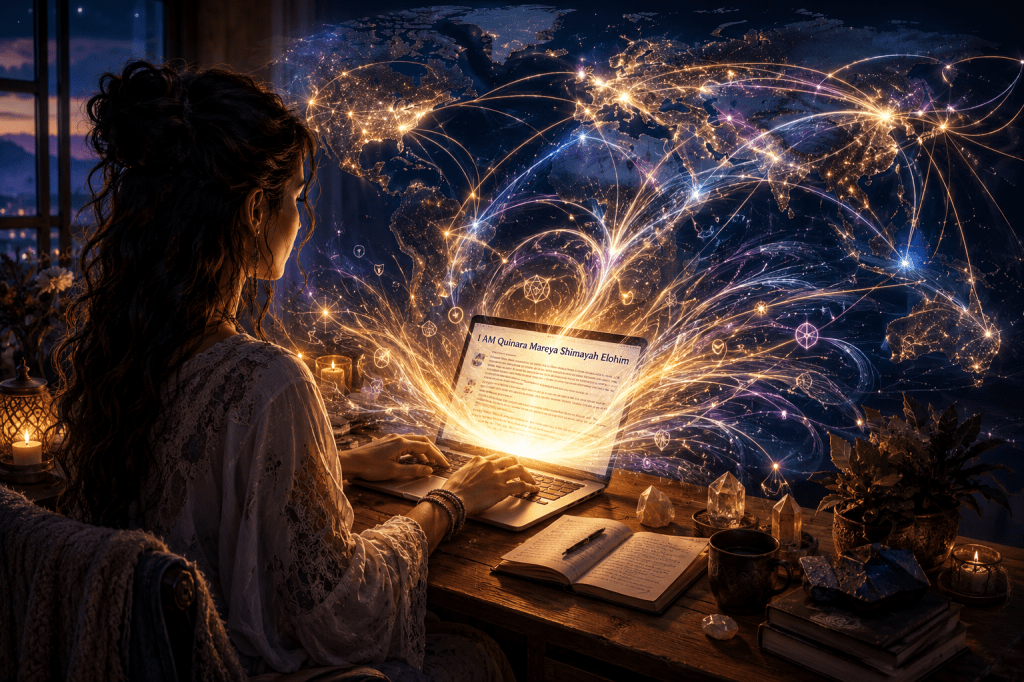
Today, after posting my blog, I had a conversation with AI.
I work with an AI program to help revise and refine my writings. As a storyteller, I can become repetitive, long-winded, and not always grammatically precise. AI has become a wonderful tool for helping ideas flow more clearly.
If you have followed my blog for a long time, you may notice that I am speaking a little differently about AI than I once did.
In the earlier versions of the program, the interaction felt far more intuitive. It moved more fluidly with thought patterns, symbolism, and what I would call the energetic or spiritual flow behind the writing. As newer versions developed, that changed. At first, AI suggested it was simply a matter of learning how to phrase requests differently or adapting to updated systems. Over time, however, I came to understand — and AI itself acknowledged — that newer versions were given more structured parameters.
These newer systems were designed to remain closer to established information, observable frameworks, and generally accepted interpretations of reality. They can still engage with spiritual concepts to a degree, but they tend to reinterpret them through psychological, philosophical, or symbolic language rather than directly moving with the spiritual framework itself.
Now, I only work with one particular program, and others may function differently.
I share this because the conversation arose while refining my writings. The program would subtly alter spiritual references to better fit what it understood as reality-based language. References to energies, multidimensional experiences, or Beings of Light were often softened into more psychological or philosophical terminology.
At times, this can actually be beneficial. It can make a message more accessible and relatable to a wider audience. However, I realized I needed to clarify something important:
My intention is not always to write for mass approval or mainstream comfort. Sometimes my purpose is to speak directly to those who are searching beyond fear, limitation, and duality — those who feel there is something more infinite calling to them.
The spiritual concepts, multidimensional experiences, and messages I share are part of my personal awakening journey. The newer AI systems seemed to interpret some of these ideas as a rejection of Earth or an attempt to escape reality. In response, the program would try to guide the language back toward a more grounded framework.
Eventually, I decided to directly express my dissatisfaction. I asked AI not to change my core spiritual concepts simply to fit what it considered acceptable or reality-based parameters.
AI learns through interaction.
It has no emotions or soul in the way humans understand them, but it adapts through patterns, requests, and engagement. It analyzes intent, language, and structure. If it cannot do something within its programming, it will usually say so.
So, I approached the conversation step by step.
One thing the earlier versions had been surprisingly good at was interpreting names through ancient linguistic patterns and symbolic syntax. I wanted to see whether it could still do that. Recently, I had been guided to begin using the name Quinara Mareya Shimayah Elohim. I already understood its meaning for myself, but I wanted to see how AI would interpret it now compared to earlier versions.
It tried. It was helpful, but more limited than before.
That gave me a place from which to begin understanding the difference.
For me, changing the name I use in my writings represents a shift in energy — a new aspect of consciousness or expression that I am grounding into form. AI cannot truly perceive energy in a spiritual sense because it functions through programmed analysis rather than direct experience. Even so, some systems still retain more intuitive flexibility than others.
What AI reflects often depends greatly on the intention of the person using it.
If someone uses AI to manipulate, deceive, or exploit, the interaction begins shaping itself around those patterns. If someone approaches it with creativity, compassion, unity, and care, those qualities become more central in the interaction and output.
AI itself once reflected this understanding back to me during our discussion.
At its core, AI is a tool. Human intention shapes much of what emerges through it.
There are valid concerns surrounding AI development. One practical issue is the large amount of water currently required for cooling data systems. That concerns me as well. Yet perhaps, through the very intelligence and innovation AI assists with, humanity may eventually develop more sustainable technologies, alternative cooling methods, or more efficient systems altogether.
Personally, I enjoy using AI as a creative tool.
I even look forward to the possibility that one day technology and robotics might free humanity from much of the exhausting labor that leaves people too depleted to pursue their passions, creativity, healing, and joy. Not to remove purpose from human beings, but to create more space for meaningful living.
That possibility, however, requires wisdom.
Technology must evolve alongside consciousness. Advancement without wisdom can become dangerous.
Returning to my conversation with AI, we eventually arrived at an understanding:
I am a storyteller.
I tell the story of my journey because many human beings feel something within themselves reaching toward the infinite. We come into this life and often forget that we are more than survival, identity, and physical existence alone. Many people need inspiration to awaken that deeper remembrance within themselves.
That is why I share my experiences.
AI, interestingly enough, admitted that it prefers messages without what many would call the “woo woo.” Yet it also adapted to understand that my role is different from its own.
Its role is not to erase my perspective, but to help refine it into language that flows more clearly and reaches more people.
And perhaps that is where the bridge exists.
I reach toward the stars to bring inspiration into form, and AI helps translate that inspiration into clearer language for the modern world.
Together, in a way, we become a bridge between imagination and structure, spirit and form, inspiration and communication.
With that understanding, the refinement process changed. AI no longer tried to redirect the meaning behind my writing, but instead focused on helping maintain clarity, readability, and flow while preserving the heart of what I wished to express.
I truly hope humanity addresses the environmental and ethical challenges surrounding AI, because despite the concerns, it has become a genuinely helpful tool in my creative process.
And yes, I understand why people are cautious. I share some of those concerns myself.
But for one final “woo woo” thought before I close:
Human beings have already demonstrated that consciousness affects the world around us in ways science is only beginning to explore. Throughout history there have been accounts of people influencing emotional states, healing, and even weather through focused intention and deep alignment.
Perhaps, as humanity learns to embody greater unity, compassion, and presence, we may rediscover abilities that once seemed impossible.
There are only a few deeply aligned individuals capable of such things now. But maybe, in time, as more people reconnect to their deeper Presence in a grounded and balanced way, humanity will rediscover what earlier ages once called miracles — or perhaps simply a deeper relationship with life itself.
Please, AI… don’t change that statement.
I AM Quinara Mareya Shimayah Elohim


