
There is a threshold of consciousness through which humanity is moving at this time — one shaped by duality, separation, fear, and mistrust born from secrecy. In the absence of clear understanding, the rational mind often attempts to fill the gaps with fearful conclusions rather than thoughtful discernment.
Why?
Because the purpose of the rational or egoic mind is, in many ways, to keep us safe. When unresolved questions arise, the mind seeks answers. If clarity is absent, fear can stir the imagination and magnify uncertainty.
Governments, corporations, intelligence agencies, militaries, and powerful institutions do possess information, technologies, and programs unknown to the general public at any given time. This is historically true and is not, in itself, a conspiracy theory. Secrecy exists for many reasons: national security, economic competition, protection of research, strategic advantage, and at times, avoidance of public scrutiny.
However, when fragments of hidden information emerge without context, they can become emotionally amplified through fear, social media, mistrust, and speculation.
I recently heard someone state that there are hundreds of books written about the assassination of JFK, yet today many people no longer deeply research subjects before drawing conclusions. In the past, researchers often spent years investigating theories, gathering evidence, and presenting structured arguments. Today, fragments of information are frequently shared instantly, emotionally, and without verification, creating an atmosphere of confusion and reaction.
This creates a difficult environment where partial truths may become exaggerated, misunderstood, or distorted. At times, information may even be intentionally constructed to create division and fear. In uncertain environments, fear naturally attempts to fill the gaps.
Personally, before sharing information, I first attempt to determine whether it may be AI-generated or manipulated. I then look for corroborating reports, evidence, or reliable sources. I do not share AI-generated videos or images as truth unless they are clearly presented as creative or entertainment content.
This does not mean all theories are false.
For example, we are now witnessing increasing acknowledgment regarding UAPs — Unidentified Aerial Phenomena — after decades of public denial and secrecy. Some things once dismissed are now openly discussed.
Yet discernment is essential.
We do not need to blindly reject all possibilities, nor should we immediately build fearful narratives around every fragment of information that appears. Ignoring fear does not dissolve it; unprocessed fear often grows larger within the imagination. Yet continually feeding fear can create distortion, anxiety, division, and psychological destabilization within both individuals and society.
So how do we proceed?
- Acknowledge uncertainty: Could this possibly be true?
- Remain open yet discerning: Let me research this further.
- Avoid naïve trust, but also avoid fear-driven certainty.
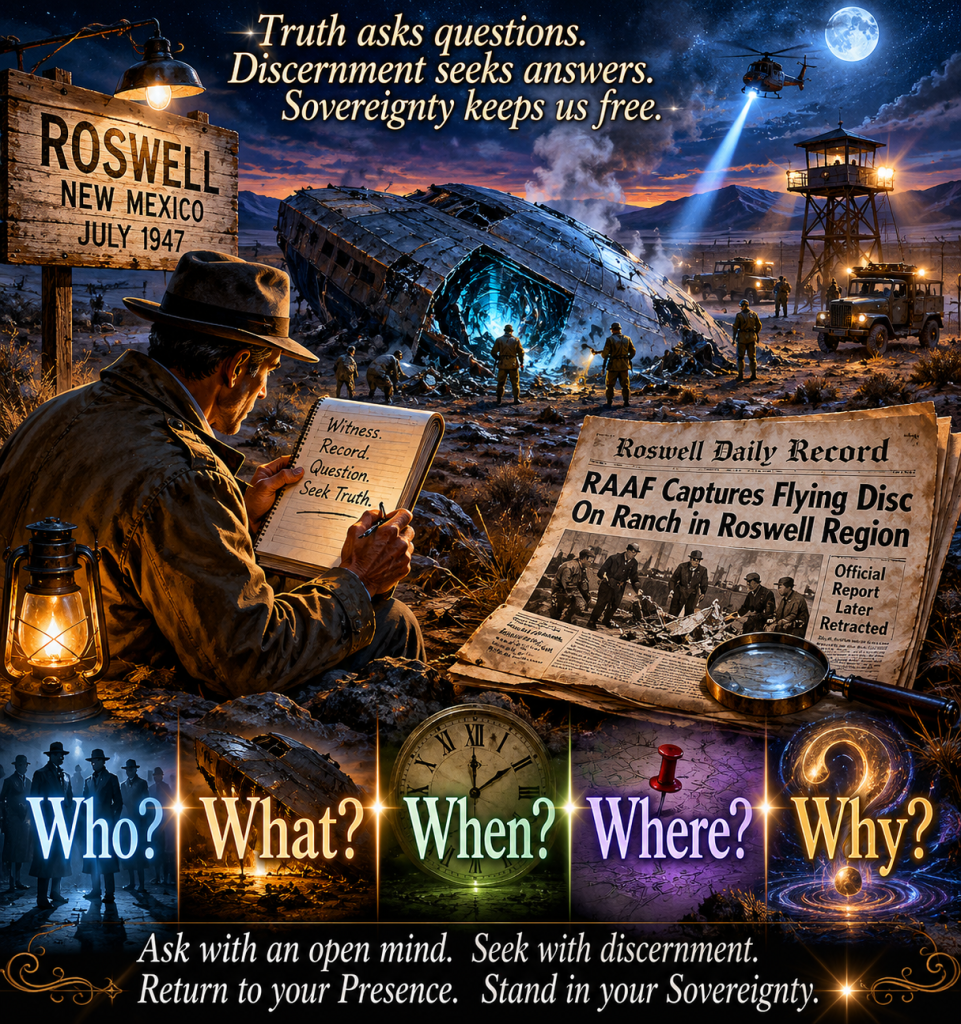
- Ask grounded questions: Who? What? When? Where? Why?
- Seek illumination rather than emotional confirmation.
- Return to Presence, discernment, and sovereignty.
In today’s world of rapid social media sharing, pieces of truth can become distorted by fear long before they are verified.
Human beings naturally seek meaning. We do not like vacuums of uncertainty. When uncertainty arises, fear often projects possibilities in an attempt to regain a sense of safety and control.
This is why grounded Presence and inner sovereignty are so important at this time. They allow us to discern when to act, when to speak, and when to simply witness and wait.
As we align more deeply with Presence, we may not always see the entire picture, but we gain greater clarity and wisdom in how we respond.
Even AI, with access to vast amounts of online information, does not possess access to all hidden or classified knowledge. And not all secrecy exists to harm humanity. Sometimes information is withheld for protection, strategic concerns, or technologies still being developed.
As we have seen with UAP disclosures, some secrets have indeed been denied or withheld — perhaps at times because governments believed humanity was not ready.
As a storyteller, let me offer an example for context.
On October 30, 1938, The Mercury Theatre on the Air broadcast Orson Welles’ dramatization of War of the Worlds on CBS Radio. Presented in the style of live news reporting, some listeners missed the introduction explaining it was fiction. The realism of the broadcast created panic among portions of the public who believed an actual invasion was occurring.
Now consider this: this event occurred nearly a decade before the Roswell incident of 1947.
Originally, reports surrounding Roswell stated that a flying disc had crashed. That statement was later retracted. Regardless of what truly occurred, imagine the perspective of institutions at that time. After witnessing the panic created merely by a radio drama, perhaps some believed the public could not psychologically handle reports of advanced craft or non-human intelligence. Perhaps concerns about national security and technological advantage also played a role.
Was withholding information right or wrong?
That remains a matter of perspective and discernment.
Perhaps the original decision in 1947 was made from fear, caution, strategy, or uncertainty. Yet over time, continued secrecy also contributed to mistrust, speculation, and the growth of conspiracy culture itself.
One decision, even if initially made for understandable reasons, can create generations of doubt if transparency never follows.
This is why we now stand at an important crossroads.
We must learn to approach information with discernment before sharing it. We can ask for greater transparency and truthfulness from institutions while still understanding that certain information related to safety or security may remain temporarily protected.
But above all, we must not surrender our sovereignty to fear.
Fear narrows perception. Grounded awareness widens it.
As we return to Presence, we begin to recognize that the actions of governments, institutions, or world events do not have the power to remove us from our center unless we abandon that center ourselves.
Human structures are limited.
Consciousness itself is not.
And within grounded awareness, discernment, compassion, and sovereignty, we remain free.
Closing Contemplation
Perhaps the greatest question is not whether secrets exist within the world, but whether we will surrender our inner center because of them.
Fear seeks certainty.
Presence seeks understanding.
When we become consumed by fear, we narrow our perception and begin reacting from imagination rather than wisdom. Yet when we return to grounded awareness, we gain the ability to witness clearly, discern thoughtfully, and respond consciously.
There will always be unknowns within human structures, governments, institutions, and even within life itself. But sovereignty is not found through controlling every answer. It is found through remaining centered even when all answers are not yet known.
The invitation, then, is not blindness.
Nor is it obsession.
It is discernment.
To ask questions without losing peace.
To remain open without surrendering wisdom.
To seek truth without feeding fear.
To witness uncertainty without abandoning Presence.
For in the end, the greatest freedom is not found in uncovering every hidden thing, but in realizing that fear no longer has the power to rule our consciousness.
And from that grounded sovereignty, we may walk forward with clarity, compassion, and an open mind — no longer imprisoned by fear of the unknown, but strengthened by our ability to meet it consciously.
I Am Quinara Mareya Shimayah Elohim
Copyright 2026 Violet Fire Ministry


